About

Profile picture

I am a CS Ph.D. student at Cornell University, advised by Prof. Alexandra Silva and Prof. Andrew Myers. My research interests are in programming languages and formal verification, with recent work on probabilistic programming and concurrency. I am also a mentor at Cornell’s Math+AI, working on benchmarks and tools for autoformalization with Prof. Daniel Halpern-Leistner.

Before Cornell, I graduated from the University of Pennsylvania with a B.S.E. and M.S.E. in Computer Science from Penn Engineering and a B.S. in Economics from Wharton. I was a member of Penn’s PLClub, advised by Prof. Steve Zdancewic, where I worked on Verifying LLVM (Vellvm), differential testing for LLVM compilers, and linear logic. I was a Wharton Research Scholar supervised by Prof. Sanjeev Khanna on knapsack problems with precedence constraints.

Publications

[arXiv] Oblivious Probabilistic Outcome Logic: Verifying Probabilistic Programs with an Oblivious Adversary
Hanxi Chen, Noam Zilberstein, Andrew C. Myers, Alexandra Silva
Abstract

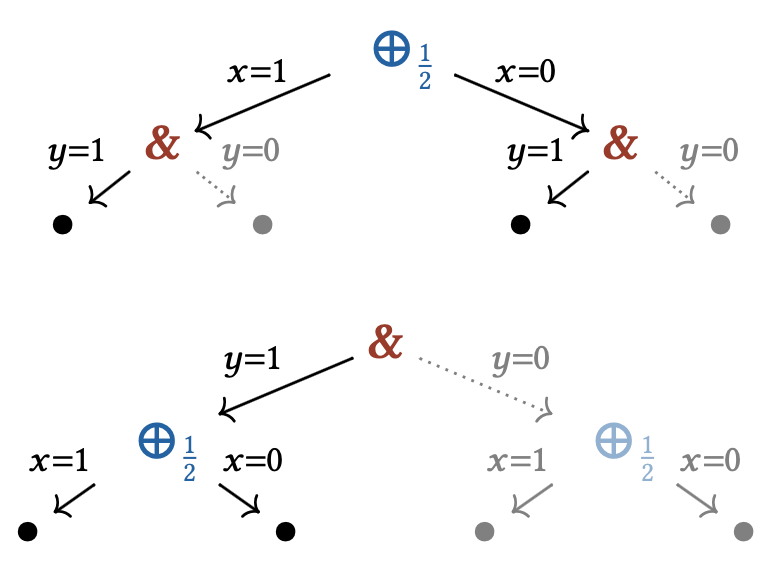
In the context of probabilistic programs, an oblivious adversary resolves nondeterminism without seeing the outcomes of random draws. Obliviousness is a common assumption in online algorithms and distributed protocols, but the complex interaction between random draws and adversarial choices makes it challenging to reason about correctness. While there has been significant progress toward reasoning about programs that combine randomization with nondeterminism, most of the work has focused on the adaptive model, whose omniscient view of program state is too powerful to establish correctness for certain classes of programs. We introduce Oblivious Probabilistic Outcome Logic (opOL), a new logic for reasoning about probabilistic programs with nondeterminism controlled by an oblivious adversary. Building on Outcome Logic and Probabilistic Separation Logic, opOL models adversarial choice as a resource and uses probabilistic independence to ensure that random outcomes are hidden from the adversary. The opOL proof system provides expressive and compositional rules for case analysis on both random and nondeterministic outcomes, and for proving almost-sure termination. Expressivity is tested through several case studies, including a paging algorithm and a leader election protocol. The opOL metatheory and case studies are mechanized in Lean 4.
[NFM'25] Vellvm: Formalizing the Informal LLVM (An Experience Report)
Calvin Beck, Hanxi Chen, Steve Zdancewic
Abstract

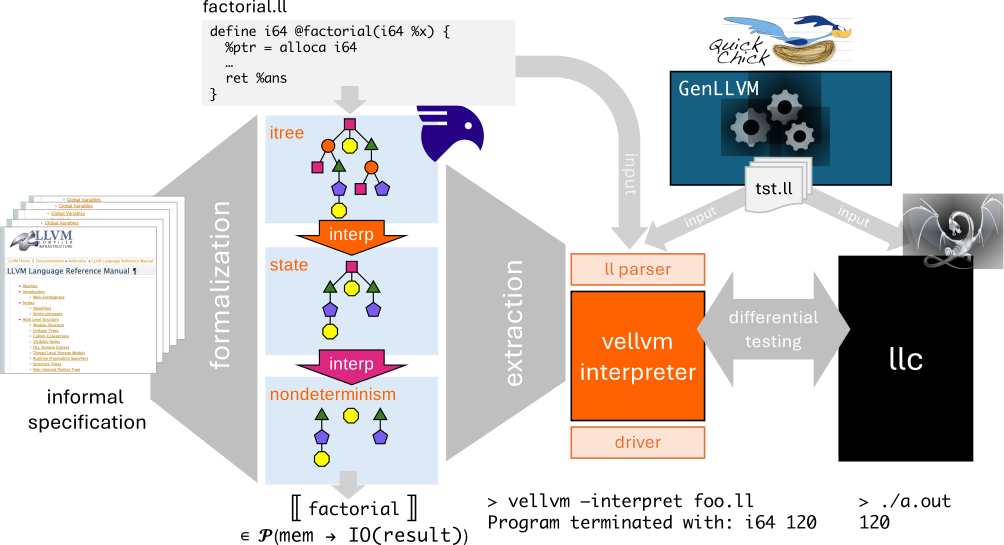
This report presents our methodology for and experience with formalizing a specification of LLVM IR in the Verified LLVM Project (Vellvm). Vellvm provides a specification for a large, practical subset of LLVM IR in the Rocq Proof Assistant in the support of verified compilers and program transformations. Program transformations often rely on the subtle details, and as a result Vellvm's semantics are quite comprehensive: for instance we provide a sophisticated low-level memory model to support low-level operations, such as casts between pointers and integers, and justify optimizations in their presence. Our approach implements the semantics via monadic interpreters, which rely on a coinductively-defined data structure called ITrees. Crucially, this methodology supports the extraction of an executable interpreter, proved to refine the specification. We use the reference interpreter to validate the accuracy of the formalization, employing random differential testing between Clang and Vellvm implemented in our own LLVM IR program generator (GenLLVM), as well as via state-of-the-art C compiler testing frameworks (CSmith and YARPGen). Such testing has found bugs in both the Vellvm semantics and Clang. We believe that tools from the Vellvm project can be useful for other LLVM IR-related projects, and that the overall methodology applies to other formal verification efforts.

[CoqPL'25] Vellvm: Formalizing the Informal
Calvin Beck, Hanxi Chen, Steve Zdancewic
Abstract

The Vellvm project is an extensive undertaking to formalize a large subset of LLVM IR in the Coq proof assistant. LLVM IR is an intermediate language that is widely used as a common target for front-end compilers. Compilers for different languages can share the LLVM infrastructure for performing optimizations and generating target code for various instruction set architectures. The bedrock of many languages is LLVM IR, and formalizing it gives us an important tool for compiler verification efforts. In this talk we will explore the difficulties that come up when attempting to formalize a large real world language. We'll touch upon how proof assistants like Coq can reveal issues in informal specifications, how testing tools like QuickChick can help bridge the gap between informal real world implementations and our formal Coq semantics, and we will also touch upon aspects of the LLVM IR could be updated to better suit verification efforts. Furthermore, we'll discuss some of the challenges we have encountered along the way, including limitations with the Coq type system, extraction bugs, and performance issues for proofs and extracted code.

[ICFP'24] A Two-Phase Infinite/Finite Low-Level Memory Model: Reconciling Integer–Pointer Casts, Finite Space, and undef at the LLVM IR Level of Abstraction
Calvin Beck, Irene Yoon, Hanxi Chen, Yannick Zakowski, Steve Zdancewic
[Mentioned in MIT PL Review]
Abstract

This paper provides a novel approach to reconciling complex low-level memory model features, such as pointer–integer casts, with desired refinements that are needed to justify the correctness of program transformations. The idea is to use a "two-phase" memory model, one with an unbounded memory and corresponding unbounded integer type, and one with a finite memory; the connection between the two levels is made explicit by a notion of refinement that handles out-of-memory behaviors. This approach allows for more optimizations to be performed and establishes a clear boundary between the idealized semantics of a program and the implementation of that program on finite hardware. The two-phase memory model has been incorporated into an LLVM IR semantics, demonstrating its utility in practice in the context of a low-level language with features like undef and bitcast. This yields infinite and finite memory versions of the language semantics that are proven to be in refinement with respect to out-of-memory behaviors. Each semantics is accompanied by a verified executable reference interpreter. The semantics justify optimizations, such as dead-alloca-elimination, that were previously impossible or difficult to prove correct.

Research

Current Projects

opOL: Oblivious Probabilistic Outcome Logic
Practical randomized protocols in distributed systems and hardware often rely on oblivious adversaries, but randomization + control flow can leak entropy through schedule consumption, making their correctness subtle to reason about. opOL develops a program logic, mechanized in Lean for verifying probabilistic programs against oblivious adversaries.
Type-Confusion Security
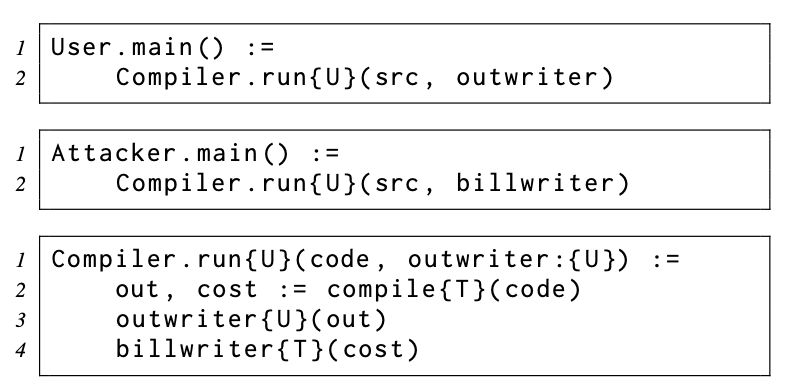
In decentralized systems, untrusted components can ignore the type system and lie about the interfaces they provide, causing type confusion to surface as confused-deputy and reentrancy attacks. This project, led by Dr. Silei Ren, develops a formal notion of type-confusion security, along with static and dynamic information-flow checks to enforce it.
Autoformalization
Autoformalization asks AI systems to translate mathematical statements and proofs into Lean code. Cornell’s ongoing Math+AI project, led by Prof. Daniel Halpern-Leistner develops challenging research-level benchmarks, a survey for comparing Lean proofs, a collection of formalization problems, and LaTeX-to-Lean proof tooling.

Selected Past Projects

Vellvm: Differential Testing for LLVM
LLVM IR is a widely used compiler intermediate representation whose official semantics are informal. Developed in Prof. Steve Zdancewic’s group, Vellvm formalizes a practical subset of LLVM IR in Rocq, including a memory model for optimization reasoning and differential testing to validate the semantics and find LLVM bugs.
Knapsack Problems with Precedence Constraints
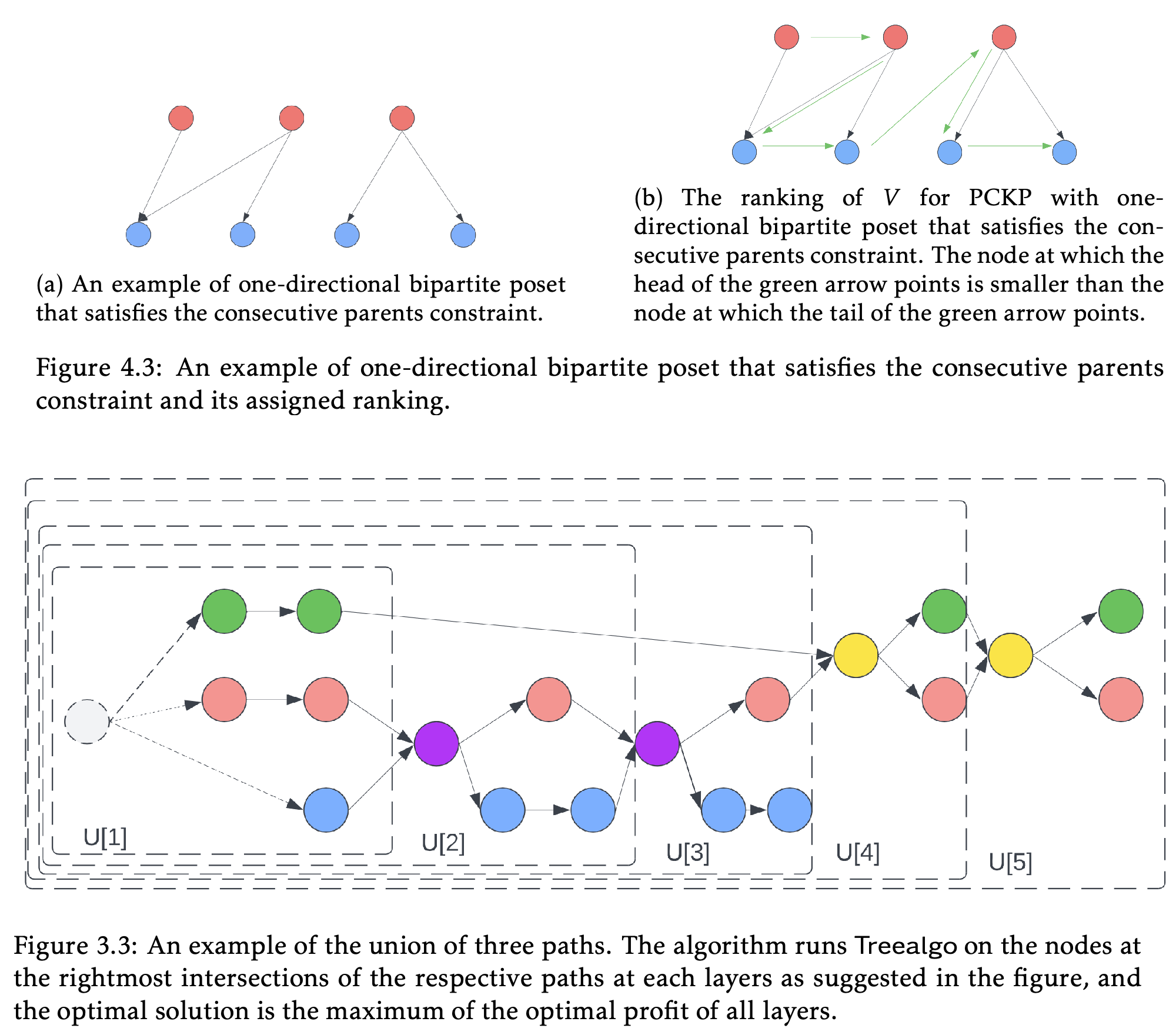
Real-world knapsack problems, including cryptocurrency mining and inventory planning, often involve dependencies. However, precedence-constrained knapsack is strongly NP-hard in general. This project studies special graph classes where exact pseudo-polynomial algorithms are possible.